
Today, May 19th, 2025, is the keynote day of Microsoft Build, where Microsoft announces its big new tech innovations. You won’t be surprised; there’s a lot of Copilot in the announcements. You can’t get around it if you have any toolset in the cloud; there will be AI waiting for you to help you.
Bad times?
Well, no. Microsoft often tells us that Copilot is here to help you and make your work easier. Truth be told, they said that about Clippy, too, and you know how that ended. Then again, Clippy was decades ago (yes, you’re that old. Oh wait, I am as well). Anyway, the days of Clippy are far behind us, and its offspring, Copilot, has surpassed it on every level.
The good thing is the improving quality. If you’ve been using an agent, Copilot, ChatGPT, Claude, or any other one, you’ll notice improvements in the models.
But this doesn’t mean that it’s perfect for every tool. For instance, I like the fact that Copilot can summarise a meeting I’ve dropped in late or create a summary on a Word document. But don’t try to write an email for me. I still think I can handle that. The same goes for social media posts. Don’t interfere there. I don’t want all those silly icons in my posts. My choice, my style.
So? Why this blog, then?
Well, as you might have seen from other blog posts, I’ve been playing around with SQL Copilot for quite some time—I think it’s more than a year now. I started with Azure SQL Copilot in the Azure portal and the query editor. Then, I was allowed to test the SSMS Copilot integration. I’ve seen it grow from an addition that could be right to an excellent assistant giving great answers.
As an MVP, I like to be on the cutting edge of technology, whether bleeding or whatever other sharp edges there are. So yes, I’m more likely to appreciate new technology. I’m very privileged to dig into the latest tech at a very early stage, and that does colour my opinion.
If you’re an experienced SQL developer, query tuner or administrator, you might think Copilot is something that gets in your way or should be treated as a junior assistant. That would be wrong; you should consider it an eager helper to help you do your job more efficiently.
But when you’re the accidental DBA, the support specialist at an organisation where you get new databases monthly without sufficient time to dig in, or you’re beginning your career, Copilot will quickly become your best friend. Because you can chat with it and learn about the database, the setup and intricacies. It will give you great answers, generate code that will work, and get the job done. Maybe the code won’t be as highly efficient as the earlier-mentioned experienced developer, but it will get the job done. And sometimes that’s all you need.
As an example, here is a screenshot from something I recorded earlier.
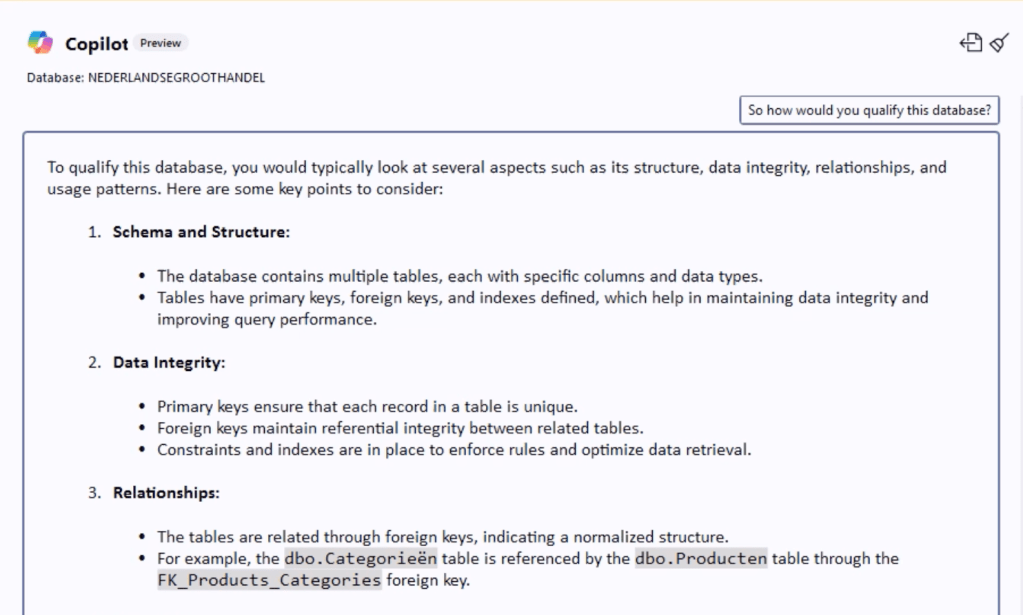
The context you need for this image is that I played the role of an accidental DBA who just got handed a new database. I wanted to know things about the database, so Copilot previously gave me information on the tables, columns, and general structure. Now, I want to know what kind of database this is; mainly, I’d be interested in whether it’s an OLTP or a Data Warehouse database. Copilot is showing its work and talking me through the process.
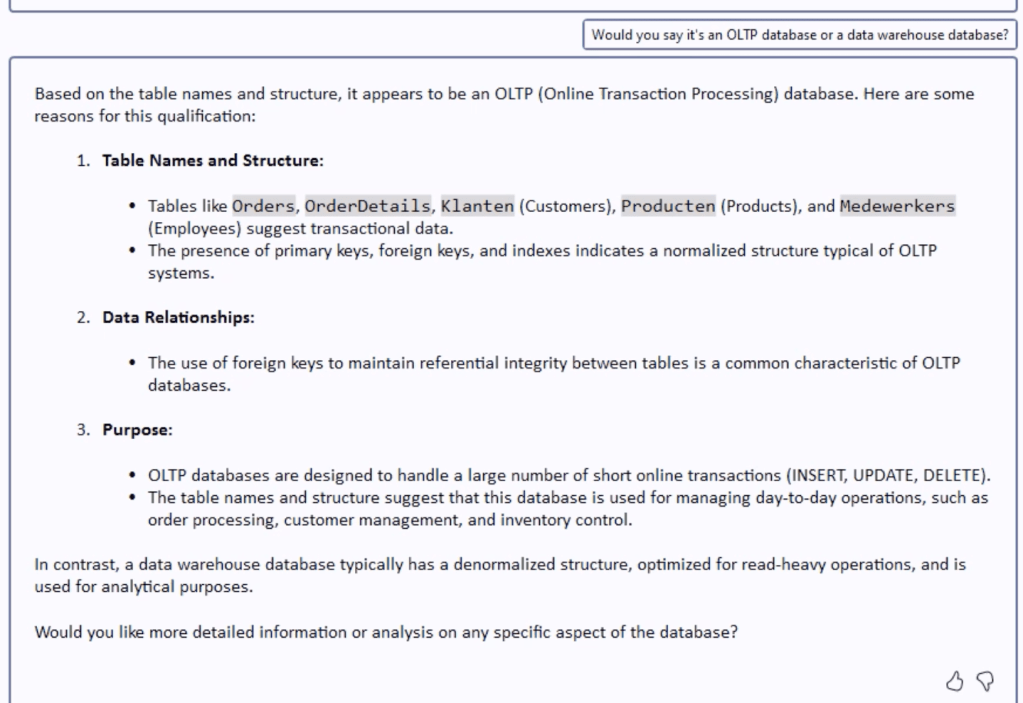
After showing me what it would do, I asked it what it was. And it gave me this answer. Correct. Granted, not the most challenging question, but when you’re busy, it’s convenient to just see this on your screen. It’s helping you do your work faster.
What about security?
The big question! And a perfect one that you should keep asking. Because we don’t want our data to leave the organisation, right? No, we don’t. So the fundamental promise of Copilot is that it won’t use your data to train the model.
Follow this link to get details from Microsoft on their attitude towards data retention and how to enable Copilot in SSMS.
So, what now?
Good question! Here’s my answer. Go and try it out. And provide feedback to Microsoft. I’ve done it a lot and can honestly say they’ve read it all and responded. And not all my feedback was honoured. Because Microsoft has to provide for a broad user base, and one weird Dutchie doesn’t rule the SSMS world 😉
 Reitse's blog