

The DP-800 training is new and was released to GA a few weeks ago. It now sits in the same family as DP-600 (Data Analytics using Microsoft Fabric), 700 (Data Engineering using Microsoft Fabric) and 750 (Data Engineering using Databricks).
The full name of this training is “Develop AI-Enabled Database Solutions“. This one sparked my interest, mainly because of the word Database. I’m not an AI fanboy per se; I like the way an AI agent can help me, but I’ll never let it run my mailbox, calendar or anything else in the background.
So last week I decided to dig into the Microsoft Learn content and find out what’s on offer.
Three main topics
And these are not little pigs either. When you select the DP-800 training, you’re faced with the three main ingredients of the course:
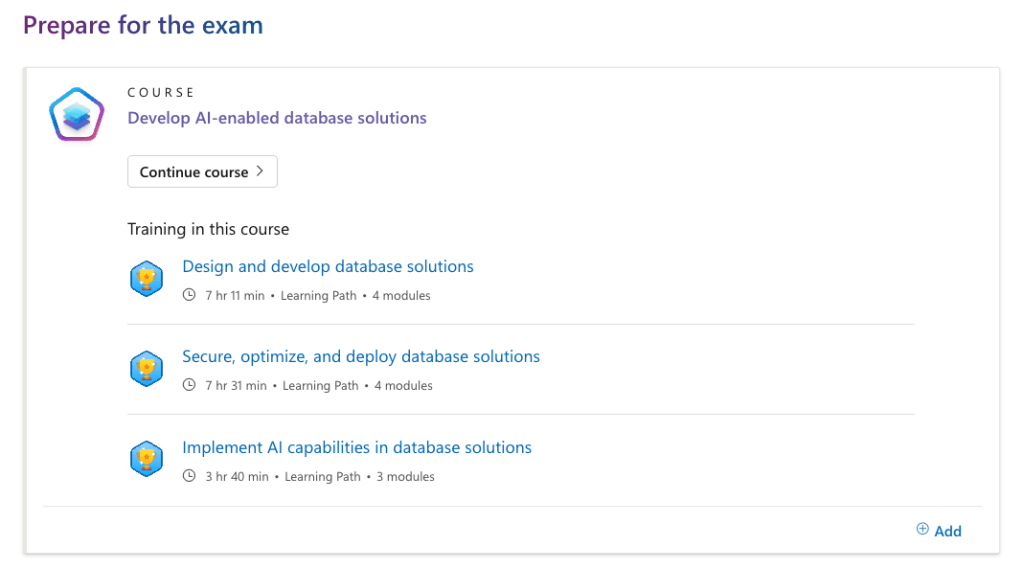
Now, what struck me is that part one is on designing and developing database solutions. Part two is about securing, optimising, and deploying database solutions and only in part three is it about implementing AI capabilities in database solutions.
If you’ve watched Microsoft Build this year, it was AI all over the place. I personally think Microsoft is selling itself short there, as they’re doing a whole lot more than just AI, but it’s their choice. Seeing this training and knowing only one-third of it focuses on AI is good. Because there is so much more to databases than AI.
The skills
- Design and implement database objects
- Implement programmability objects
- Write advanced T-SQL code
- Design and implement SQL solutions by using AI-assisted tools
- Implement data security and compliance
- Optimize database performance
- Implement CI/CD by using SQL Database Projects
- Integrate SQL solutions with Azure services
- Design and implement models and embeddings
- Design and implement intelligent search
- Design and implement retrieval-augmented generation (RAG)
Which platform?
Another thing Microsoft is really pushing is Fabric SQL Database, the serverless Azure SQL database implementation inside Microsoft Fabric. Again, I was expecting a lot of Fabric SQL in the course, but apart from a few mentions, it’s mostly Azure SQL Database.
Which is perfectly fine; in this age, when things are more cloud-oriented, focusing on Azure SQL Database makes sense. The good thing is that most, if not all, of what you’re learning in this course can be done on your SQL Server 2025 instance as well.
This means you’re not bound to a cloud solution. If you’re considering a cloud exit, you can retain your code and migrate it to your on-premises environment.
Learning experience
In the past, when reading through the pages, I sometimes felt it was quite high-level. Yes, the topics were covered, but that was about it. In these specific paths, I found it not the case. Of course, you won’t find the depth and breadth from the real specialists, but I don’t think that’s the goal here.
I was very happy to read up on topics like performance tuning, query store, extended events, and many other excellent, mature, and proven technologies in the data platform world. But also new additions like JSON and Vector data types, and RegEx. When you look at the skills list above, you can see that there are many recognisable elements from earlier SQL certifications. If you’re all set with those, you can really focus on the new things, like models, embeddings, intelligent search, and RAG.
Every unit has a lab. You need your own resources, but the lab will guide you to what needs to be done. Nothing too complicated, but it’s way better than just reading. The questions at the end of the modules are a little harder than they used to be. Also, to pass the assessments at the end, you now need a certain percentage of correct answers.
So, read, practice, succeed?
Basically, yes. Read through the content, take the labs. But do not stop there and think you’ll pass the exam. Because unless you’ve got more hands-on experience, I’m guessing it won’t be enough. I haven’t taken the exam yet (at the time of writing, early June 2026), but will do so as soon as I can.
Also, if the whole agentic/ai thing still feels new to you (and that’s OK! Not everyone is always at the forefront and working with the latest things), you can consider reading up on the AI fundamentals track. I did, and it helps understanding the different terms and how all the pieces work together.

